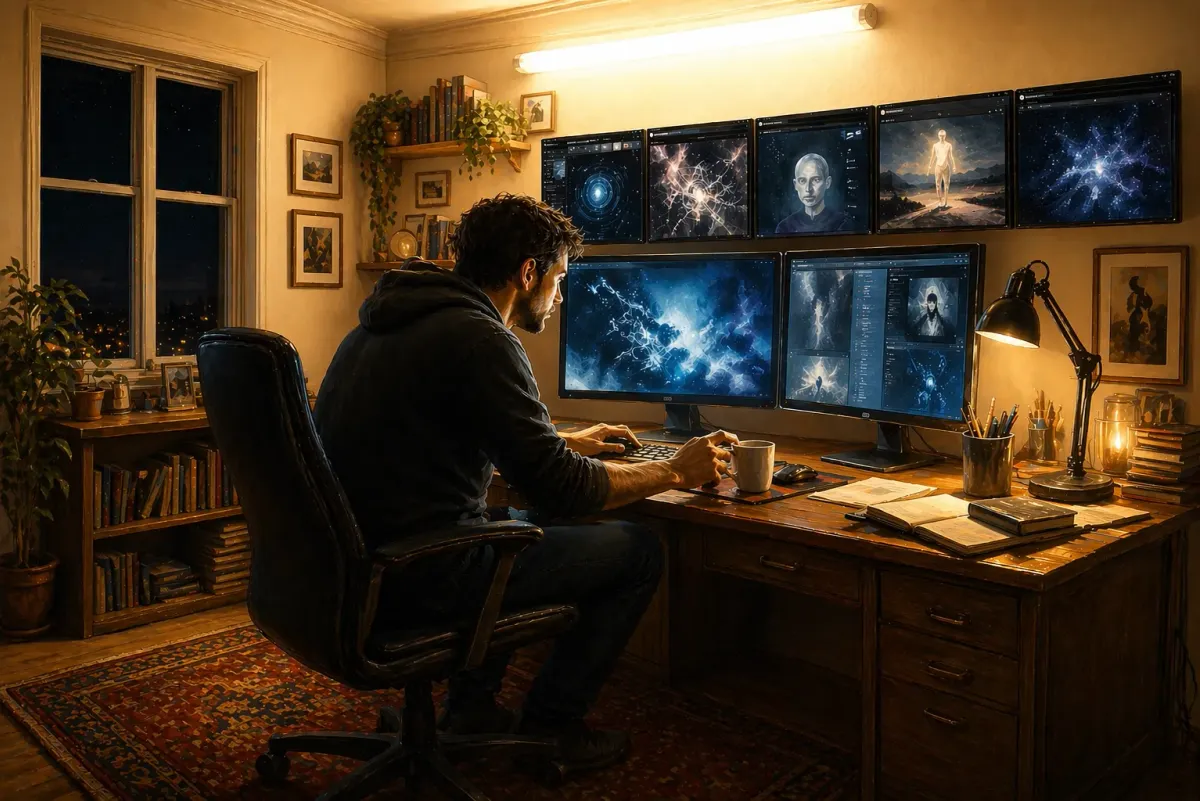
Building with AI has become the most potent cognitive drug available to founders, and if you run a neurodiverse brain—ADHD, dyslexic, autistic, any brain wired on a different dopamine economy—the compulsion is not metaphorical but pharmacological. AI tools deliver instant feedback, variable reward, and scalable challenge in an endless loop, exploiting the same reward-sensitivity that makes hyperfocus feel like flow but function like addiction. The rotation starts innocently: Manus for data, Lovable for builds, Claude for copy and design, GPT for research. Five tools, five parallel streams, no natural pauses. It looks like extraordinary productivity at 2 am, but the quality of decisions made under that cognitive load tells a different story. This is a piece about the loop, the crash signal that arrives days later, and why stopping has turned out to be harder than writing any prompt.
It is 2:07 am on a Wednesday, and I am hunched over two monitors with twenty browser tabs open, each one running a different AI tool, each one doing something I cannot bring myself to stop watching. I tell myself I will close the laptop after the next prompt. I do not close the laptop.
What makes this strange is that three months ago I buried my father, and when I thought about the period that would follow, I imagined something closer to fog. I'd been his caretaker for the previous 5 months, most of the time spent getting in and out of hospitals. At the end, I was completely worn down. I expected to spend months easing my brain back into a state where it could work. I pictured slow mornings, half-finished sentences, the dull hum of concentration that will not quite catch. Instead I find myself more engaged than I have been in years, and the engagement is not the gentle return I was braced for. It is a spike, a wire in the wall I cannot stop touching.
Building with AI has become the most potent cognitive drug I have ever encountered, and if you are a neurodiverse founder, someone whose brain already runs hotter and faster and less linearly than the manual says it should, this is not a metaphor but a pharmacological description.
The Loop
Here is what the loop looks like at 2 am. I have a task running in Manus, pulling data through a research pipeline I set up an hour ago. While it processes, I switch to Lovable, where a front-end build is compiling. While that compiles, I open Claude, because I need copy for a landing page and Claude writes in a way I can edit into my own voice faster than I can draft from scratch. While Claude generates, I flip to Claude's design tools because I need a 3d dynamic header that matches the copy I have not finished reading yet. While that renders, I open GPT, because I want a second opinion on the research Manus returned, and GPT's image generation handles a particular style I need for social cards.
Five tools, five parallel streams, each one returning results on a slightly different cadence, which means there is never a gap. The moment one finishes, another needs input. The moment I provide input, a third one delivers output. The cycle has no natural pause, no breath, no moment where the brain says that is enough for tonight.
Poor Gemini rarely gets a look in, because I have already filled every slot in the rotation.
This looks like productivity, it is the architecture of compulsion.
Why It Hooks the Neurodiverse Brain
The neuroscience is not complicated. Dopamine, the molecule that makes your brain say "do that again," responds to three things with particular intensity: instant feedback, variable reward, and the sensation of mastery over a challenge that sits right at the edge of your ability. AI tools deliver all three simultaneously, in an endless loop.
You type a prompt, and within seconds something comes back. That is the instant feedback. But what comes back is never quite what you expected, sometimes better, sometimes worse, sometimes sideways in a way that opens a door you did not know was there. That is the variable reward, the same mechanism that makes slot machines work. And the act of refining the prompt, of learning the tool's personality, of getting closer to the output you imagined, is the mastery challenge. Each iteration tightens the gap between what you wanted and what you got.
For a neurotypical brain, this is engaging. For an ADHD brain, a dyslexic brain, an autistic brain, any brain that runs on a different dopamine economy, it is closer to crack cocaine, and I am not being dramatic when I say so.
The clinical literature on ADHD and addiction is clear: the same reward-sensitivity that makes it hard to start boring tasks makes it nearly impossible to stop interesting ones. Hyperfocus may seem like a superpower, its a vulnerability wearing a cape. AI tools are specifically, precisely, almost cruelly designed to exploit that vulnerability, not by intention but by architecture. The feedback is instant, the challenge scales with you, the reward is variable, and there is always one more prompt to run.
The Surprise
What I did not see coming was the speed of the onset. I had expected to stumble back into focus over months, the way I have after previous disruptions in my life, where the brain takes its time deciding that the outside world is worth engaging with again. Whatever else this period was going to ask of me, I assumed it would slow me down for a while.
It has done the opposite. The AI rotation gives me something the rest of life cannot currently offer, which is a stream of problems that get solved on the scale of seconds. The research question I have been circling for a year gets answered in a paragraph. The visual I could not draw appears on the screen. The code I would have written over a weekend writes itself in an afternoon. Every pull of the lever pays out, and each payout is small enough that the next one feels close, and the one after that, and the one after that.
I did not expect to find the most compelling thing in my life sitting on my desk. I had assumed the compelling things were elsewhere, and that my job in this period was to tolerate their absence. Instead I find myself working later than I used to, more intensely than I used to, and with a sense that stopping is not merely difficult but actively unpleasant, like turning off a song two beats before the drop.
The Rotation Problem
There is a specific behaviour pattern I want to describe because I suspect other founders will recognise it. I call it the rotation. You are not working on one thing, you are working on five things across five tools, and you are rotating between them the way a card dealer rotates decks: Manus for data, Lovable for builds, Claude for copy, Claude again for design, GPT for research and images. Each tool has a processing latency of ten to sixty seconds to two minutes to ten, which is just long enough to compose the next prompt for the next tool but too short to do anything else.
So you rotate, you fill the gaps, you eliminate downtime, and at some point you stop being a person working on a project and become a dispatcher managing a fleet. The rotation creates a sensation of extraordinary productivity: five streams running in parallel, outputs arriving continuously, problems getting solved in minutes that would have taken days.
Here is what I have learned, and this is the point of the piece: the sensation of productivity and actual productivity are different things.
At 2 am, the quality of my decisions is poor. The copy I approve has errors I would catch at 10 am, the design choices I make are driven by fatigue rather than taste, the research I skim is absorbed at surface level when it deserved depth. I am moving fast because the tools let me move fast, not because moving fast is the right thing to do. The tools themselves have no opinion about when I should stop, which means that judgement is my job, and I have been failing at it.
The Founder Trap
This is worse for founders than it is for employees, and worse still for neurodiverse founders. Employees have external structure: their day ends at some point, their manager (hopefully they have kind managers) notices if they look wrecked on a Tuesday morning, their work is reviewed by someone who slept. Founders have none of that. The work is boundless, the responsibility is total, and the feedback loop between effort and outcome is direct enough to feel like every hour matters, but ambiguous enough that you can never be certain you have done enough.
Add neurodiversity, and the internal regulation that might otherwise say stop is already compromised. The ADHD brain does not have a reliable stop signal for rewarding activities; what it has is a crash signal, which arrives hours or days later, usually as burnout, irritability, or an inability to function at all. Add AI tools that remove friction, provide instant feedback, and scale challenge to ability, and you have a perfect storm: a founder who cannot stop, working with tools that never ask them to, building things that are genuinely valuable, which makes the whole pattern harder to see as a problem.
Because it looks like dedication, feels like flow, and produces real output, none of which makes it healthy.
What I Am Doing About It
I do not have a clean five-step framework for this, and if I did I would not trust it. What I have instead is a set of rough edges I am trying to build into the smooth surface of the AI workflow, because the smooth surface is the problem.
I (try to) set a hard stop at 11 pm, not because 11 pm is magic, but because having a number written on a piece of paper that I can see from my desk turns an internal negotiation into an external fact. The neurodiverse brain negotiates with itself endlessly, and it negotiates less with a Post-it note that disagrees with it.
When the clock hits the number, I do not finish the current task. I close all of it, every tab, every tool, the whole rotation. The "just one more" instinct is the addiction talking, and the only way I have found to beat it is to not engage with it at all.
I have also started leaving gaps during the session itself. Instead of rotating between five tools to fill every pause, I let the pause exist. Manus is processing? I look out the window. Lovable is compiling? I make tea. The gap is where the brain recalibrates, and without it the session has no natural exit.
And I have started talking about the pattern openly, which is partly what this piece is. Not in the polished lessons-learned register, but in the plain, slightly embarrassing register, because I think a lot of founders, especially neurodiverse ones, are deep in this loop and do not yet have the language for it. It feels too productive to be a problem, too exciting to be an addiction, too useful to resist.
But you know the feeling. You know the 2 am screen glow, the promise you make to yourself about the next command being the last one, the way the hours get pushed another hour into the future every time a completed task pings.
The Question
I am not going to tell you what to do. That would be explaining the reader's own thoughts, and my brand guide has a rule about that.
What I will ask is this: when was the last time you closed the laptop and sat in the quiet? I am still learning to do it myself, and it has turned out to be harder than any prompt I have ever written.
I'll just after I finish this next one.
Notes:
Dopamine and the neurodiverse brain
1. MacDonald, Kleppe, Szigetvari & Haavik (2024). "The Dopamine Hypothesis for ADHD: An Evaluation of Evidence." Frontiers in Psychiatry. https://pmc.ncbi.nlm.nih.gov/articles/PMC11604610/
Summary: A 40-year review of evidence linking altered dopamine signalling to ADHD, covering brain imaging, pharmacology, neurochemistry, and genetic studies. The review concludes there is clear involvement of dopamine but challenges the popular simplification that ADHD equals low dopamine, noting the biological mechanisms are considerably more complex.
The dopamine-ADHD link is real and well-evidenced, but the mechanism is not a simple deficit. The ADHD brain does not just have less dopamine; it processes and regulates dopamine differently, which is why certain high-stimulus activities — including AI tool use — can trigger disproportionately intense reward responses.
2. Blum et al. (2008). "ADHD and Reward Deficiency Syndrome." Neuropsychiatric Disease and Treatment, PMC. https://pmc.ncbi.nlm.nih.gov/articles/PMC2626918/
Summary: Identifies a genetic basis for what the authors call Reward Deficiency Syndrome, where dysfunction in the brain's dopamine reward cascade — particularly involving the DRD2 gene — creates a chronically under-stimulated reward system. To compensate, the brain seeks out activities and substances that trigger dopamine release and relieve the discomfort of under-stimulation.
This is the clinical scaffolding for the cocaine analogy. The ADHD brain is not chasing pleasure; it is trying to reach a baseline that neurotypical brains maintain without effort. AI tools — with their instant feedback and variable reward — are structurally well-suited to fill that gap, which is precisely what makes them hard to put down.
3. Cortese et al. (2023). "An Overview on Neurobiology and Therapeutics of ADHD." Discover Mental Health, Springer. https://link.springer.com/article/10.1007/s44192-022-00030-1
Summary: A comprehensive review of ADHD neurobiology, establishing that dopamine receptor subtypes D1 and D2 are concentrated in brain regions governing reward circuits, learning, and locomotor activity. Patients with ADHD have a higher density of the dopamine transporter responsible for reuptake, which reduces the dopamine available at the synaptic cleft and shortens the reward signal.
The reuptake mechanism explains why the ADHD brain needs more frequent stimulation. The reward signal does not linger. Each completed AI task delivers a brief hit; the baseline drops quickly, and the next prompt feels necessary rather than optional.
Neurodiversity and addiction
4. Butwicka et al. (2017). "Increased Risk for Substance Use-Related Problems in Autism Spectrum Disorders." Journal of Autism and Developmental Disorders. https://pmc.ncbi.nlm.nih.gov/articles/PMC3965675/
Summary: Population-based cohort study finding that substance use-related problems occur in 19 to 30 percent of individuals with autism spectrum disorder. The highest risk group is individuals with both ASD and ADHD, suggesting the two conditions compound addiction vulnerability rather than simply adding together.
Comorbidity matters. Many founders carry more than one neurodiverse profile. The compounding effect means the addiction risk for someone with both ADHD and autistic traits is not double; it is significantly higher and which helps explain why the loop described in the article can feel genuinely unbreakable rather than merely inconvenient.
5. Cambridge Autism Research Centre / Lichtenstein et al. "Autism Spectrum Disorder and Substance Use." The Lancet Psychiatry. https://shantipdx.com/neurodiversity-and-addiction-is-there-a-connection/
Summary: Large-scale Cambridge study finding that autistic people are nine times more likely than non-autistic peers to use drugs and alcohol recreationally. The study also identifies a counterintuitive finding: the higher the IQ, the greater the risk of developing substance use disorder, particularly among individuals with a dual diagnosis of ADHD and autism.
The intelligence dimension is significant for a founder audience. High-functioning neurodiverse founders; the ones most likely to be building with AI tools, are in the highest risk category, not the lowest. Intelligence does not protect against compulsive behaviour; in this context it may amplify it.
6. Molina et al. (2003). "ADHD Symptoms, Autistic Traits, and Substance Use in Adult Australian Twins." Alcoholism: Clinical and Experimental Research, PMC. https://pmc.ncbi.nlm.nih.gov/articles/PMC3965675/
Summary: Cross-sectional study of 3,080 adult twins establishing that both ADHD symptoms and autistic traits are independently associated with elevated substance use and misuse. Relative to those with ASD alone, individuals with ADHD are more likely to report substance use and misuse across nicotine, alcohol, and cannabis.
Establishes the ADHD-substance link on a large general-population sample rather than a clinical one, which makes the finding harder to dismiss as a feature of treatment-seeking populations. The same reward-seeking mechanism that predicts substance misuse predicts compulsive engagement with any high-stimulus, high-reward activity.
7. Wilens et al. (2001). "ADHD and Substance Abuse: Diagnostic and Therapeutic Considerations." PubMed. https://pubmed.ncbi.nlm.nih.gov/11462745/
Summary: Clinical review establishing that the presence of ADHD predicts earlier onset of drug abuse, longer duration of substance use disorder, and a shorter interval between the onset of drug abuse and drug dependence. Individuals with ADHD are also at greater risk for treatment failure because their behavioural patterns interfere with access and response.
The speed of escalation is the critical finding here. ADHD brains do not gradually develop dependencies; the interval between first use and dependence is compressed. Applied to behavioural rather than substance addiction, this suggests the window between discovering AI tools and losing the ability to regulate their use is shorter for neurodiverse founders than for neurotypical ones.
8. NZ Drug Foundation (2024). "Neurodivergence and Substance Use." Literature review and lived experience report. https://drugfoundation.org.nz/news-and-reports/neurodivergence-and-substance-use
Summary: Synthesises the research literature alongside lived experience interviews with neurodiverse people in New Zealand. Finds that people with ADHD and ASD are more likely to engage in problematic substance use and to use substances to manage symptoms of their neurodivergence. Also notes that over 50 percent of people with childhood ADHD experience symptoms persisting into adulthood, meaning risks established in youth do not resolve.
The self-medication framing is important. Neurodiverse founders often turn to high-stimulus activities not for recreation but to regulate an under-stimulated nervous system. AI tools provide a legal, socially legitimate, and professionally productive version of the same regulation, which makes the behaviour much harder to identify as a problem and much harder to stop.
Neurodiversity and founders
9. Freeman, M.A. (2015). "Are Entrepreneurs Touched by Fire?" University of California San Francisco. https://www.adhdflowstate.com/facts-about-adhd-neurodiversity-and-entrepreneurship/
Summary: Study of entrepreneurs and comparison participants finding that self-reported mental health concerns were present in 72 percent of entrepreneurs. Entrepreneurs were significantly more likely to report a lifetime history of ADHD (29 percent), depression (30 percent), substance use conditions (12 percent), and bipolar diagnosis (11 percent) than comparison participants. ADHD prevalence in the general adult population is 4 to 5 percent.
The 29 percent figure is the single most useful data point in the entire list for this piece. ADHD is roughly six times more prevalent among entrepreneurs than in the general population. The audience most likely to be building with AI tools at 2 am is the same audience most neurologically predisposed to the compulsive loop the article describes.
10. Moore, McIntyre & Lanivich (2021). "ADHD-Related Neurodiversity and the Entrepreneurial Mindset." Entrepreneurship Theory and Practice, Vol. 45. https://journals.sagepub.com/doi/10.1177/1042258719890986
Summary: Empirical study of entrepreneurs with and without ADHD finding that ADHD-related neurodiversity is meaningfully related to the entrepreneurial mindset. Entrepreneurs with ADHD demonstrate higher levels of entrepreneurial alertness — the ability to notice opportunities others miss — and employ a more intuitive cognitive style. No significant differences in metacognition were found.
Entrepreneurial alertness is the same cognitive trait that makes AI tool rotation feel productive rather than compulsive. The ADHD founder is genuinely noticing more connections and opportunities across parallel workstreams. The problem is that the trait which makes them good at founding also removes the internal signal that says the session should end.
11. Lerner, Verheul & Thurik (2018). "Entrepreneurship and ADHD: A Large-Scale Study." Small Business Economics, Vol. 50. https://link.springer.com/article/10.1007/s11187-018-0061-1
Summary: The largest empirical study linking clinically diagnosed ADHD to entrepreneurial behaviour. Based on 9,869 participants, it finds a positive connection between clinical ADHD and both entrepreneurial intentions and entrepreneurial action — not just ADHD-like traits, but actual diagnosed ADHD predicting actual founder behaviour.
This is the study that closes the loop between diagnosis and action. It is not that entrepreneurial people happen to share some traits with ADHD; people with the clinical condition are statistically more likely to start ventures. The population most exposed to the AI compulsion loop is identifiable and measurable.
12. Tran, Wiklund, Antshel et al. (2025). "Entrepreneurship and ADHD: A Meta-Analytical Assessment." Entrepreneurship Theory and Practice. https://journals.sagepub.com/doi/10.1177/10422587251392498
Summary: The most current meta-analysis across the ADHD-entrepreneurship literature, synthesising findings that have previously been fragmented and at times contradictory. Also cites the emerging literature on hyperfocus in adult ADHD and its role in entrepreneurial performance. Published November 2025, making it the most recent authoritative source in the field.
Useful as a citation for currency and credibility. The hyperfocus literature it references is directly relevant: the same hyperfocus that drives venture creation is the mechanism exploited by the AI rotation loop.
13. Austin & Pisano (2017). "Neurodiversity as a Competitive Advantage." Harvard Business Review, May–June 2017, Vol. 95, No. 3, pp. 96–103. https://hbr.org/2017/05/neurodiversity-as-a-competitive-advantage
Summary: The foundational HBR piece establishing neurodiversity as a business asset rather than a welfare issue. Documents how SAP, Hewlett-Packard Enterprise, and Microsoft reformed hiring processes to access neurodiverse talent and reported productivity gains, quality improvement, and increased innovative capability as a result. The most-cited business press article in the neurodiversity field.
Establishes the business legitimacy of the conversation. The same cognitive traits that make neurodiverse employees and founders valuable: pattern recognition, hyperfocus, high-intensity engagement; are the ones that make them structurally vulnerable to the AI compulsion loop. The asset and the liability are the same thing operating in different contexts.
14. Aarons-Mele & Wiklund (2021). "Succeeding with ADHD." HBR IdeaCast podcast, January 2021. https://hbr.org/podcast/2021/01/succeeding-with-adhd
Summary: HBR podcast episode featuring Johan Wiklund, professor of entrepreneurship at Syracuse University and one of the leading researchers in the ADHD-entrepreneurship field. Covers the research connections between ADHD and entrepreneurial success, with particular attention to the burnout risk: when a person with ADHD finds something they genuinely enjoy, they will work at it until they crash.
Wiklund names the burnout pattern directly and in plain language, which makes this the most quotable source on the list for a general audience. The observation that ADHD founders burn themselves out doing things they love is the mechanism the article is describing, applied specifically to AI tool use.
Share this post
Shiju Thomas
Author & Leadership Coach